CSIRO RTI Series (1): What Is Radio Tomographic Imaging?
Introduction to Radio Tomographic Imaging (RTI), project scope, and system overview.
What is Radio Tomographic Imaging?
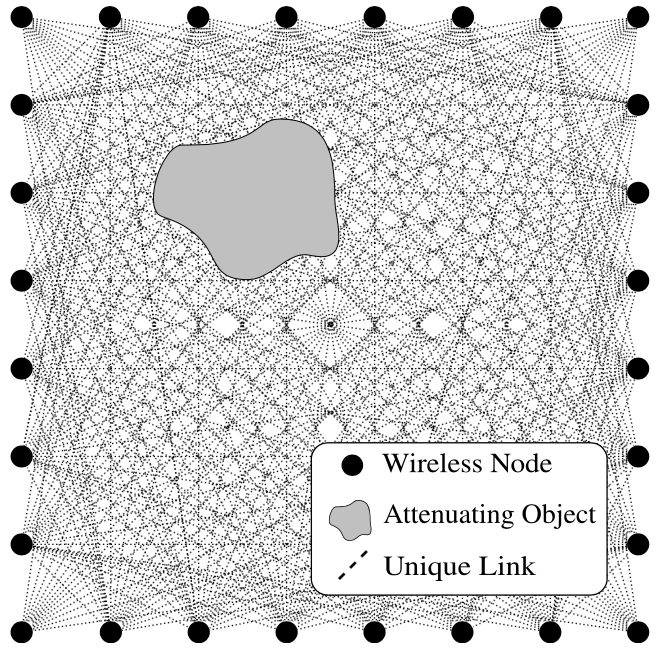
Radio Tomographic Imaging (RTI) is a technique for imaging passive objects (objects without transmitters) by using a wireless network. The key signal is RSSI (Received Signal Strength Indicator). In general, RSSI changes when an object blocks or disturbs a radio path.
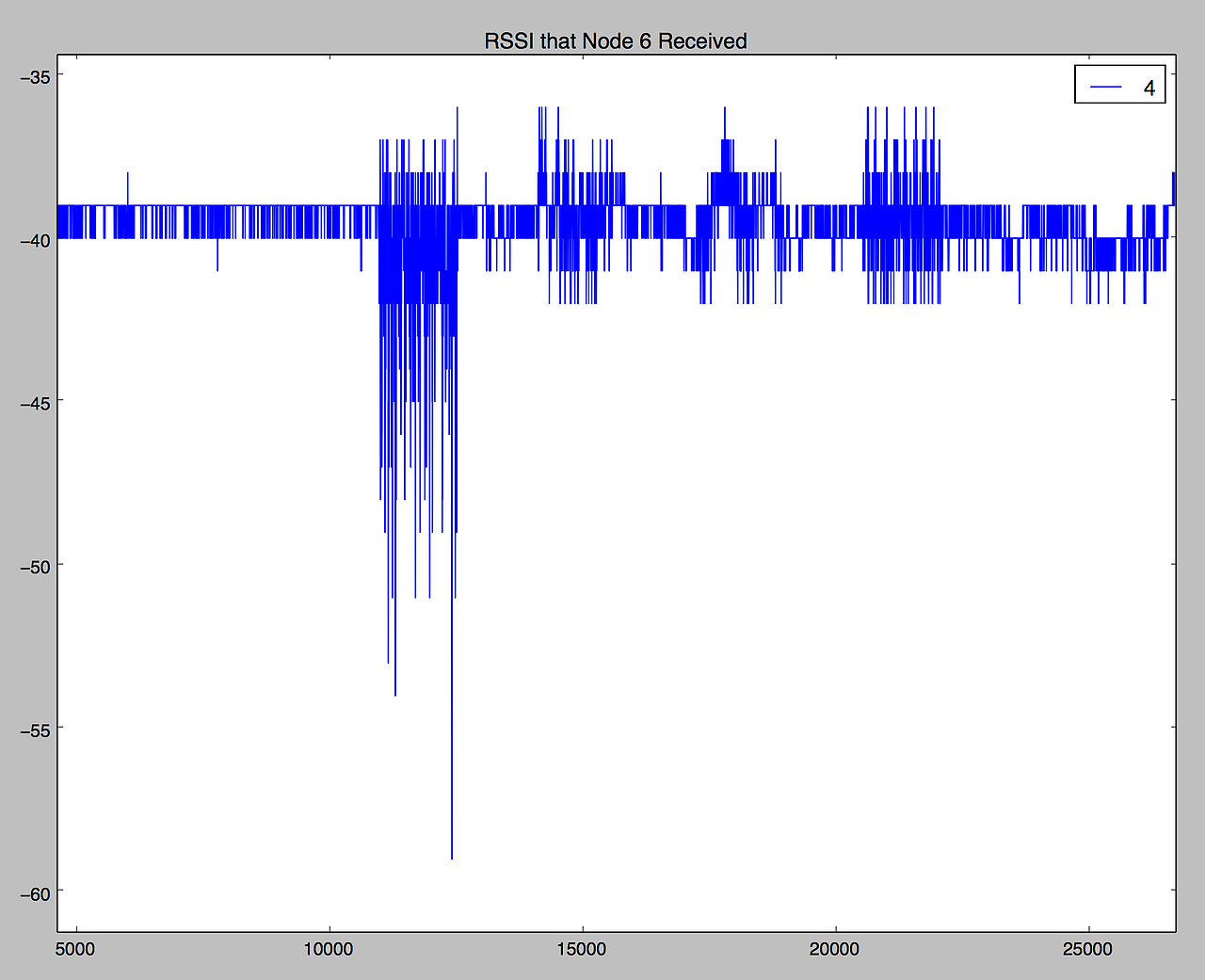
The graph above shows RSSI variation over time. During experiments, RSSI fluctuated as a person moved around the nodes. In an RTI network, nodes generate RSSI data rapidly, and we reconstruct images from that data.
During my internship at CSIRO, I worked on building an RTI system using low-power sensor devices:
- Device: TI SensorTag CC2650
- OS: Contiki
The work had two main steps:
- Build device applications for the sensor nodes.
- Reconstruct images from collected network data.
I implemented:
- Node firmware for RTI network participants
- Master-node firmware for scheduling and collection
After deploying nodes around a target area, I collected per-link RSSI data and reconstructed area images.
The next posts cover the scheduling design and reconstruction details.
Reference
[1] Wilson, Joey, and Neal Patwari. “Radio tomographic imaging with wireless networks.” IEEE Transactions on Mobile Computing 9.5 (2010): 621–632.
2026 Update Note
- This post was migrated from the original blog and language-polished in 2026.
- Core RTI concepts remain valid: passive sensing, RSSI-based attenuation tracking, and image reconstruction through link measurements.
- For modern replication, consider newer IoT stacks (e.g., Zephyr + nRF52/ESP32-class hardware) if Contiki/CC2650 toolchains are unavailable.