CSIRO RTI Series (6): Image Reconstruction
Reconstruction model and comparison of three RSSI-derived y-vector strategies.
CSIRO RTI Series (6): Image Reconstruction
Image Reconstruction
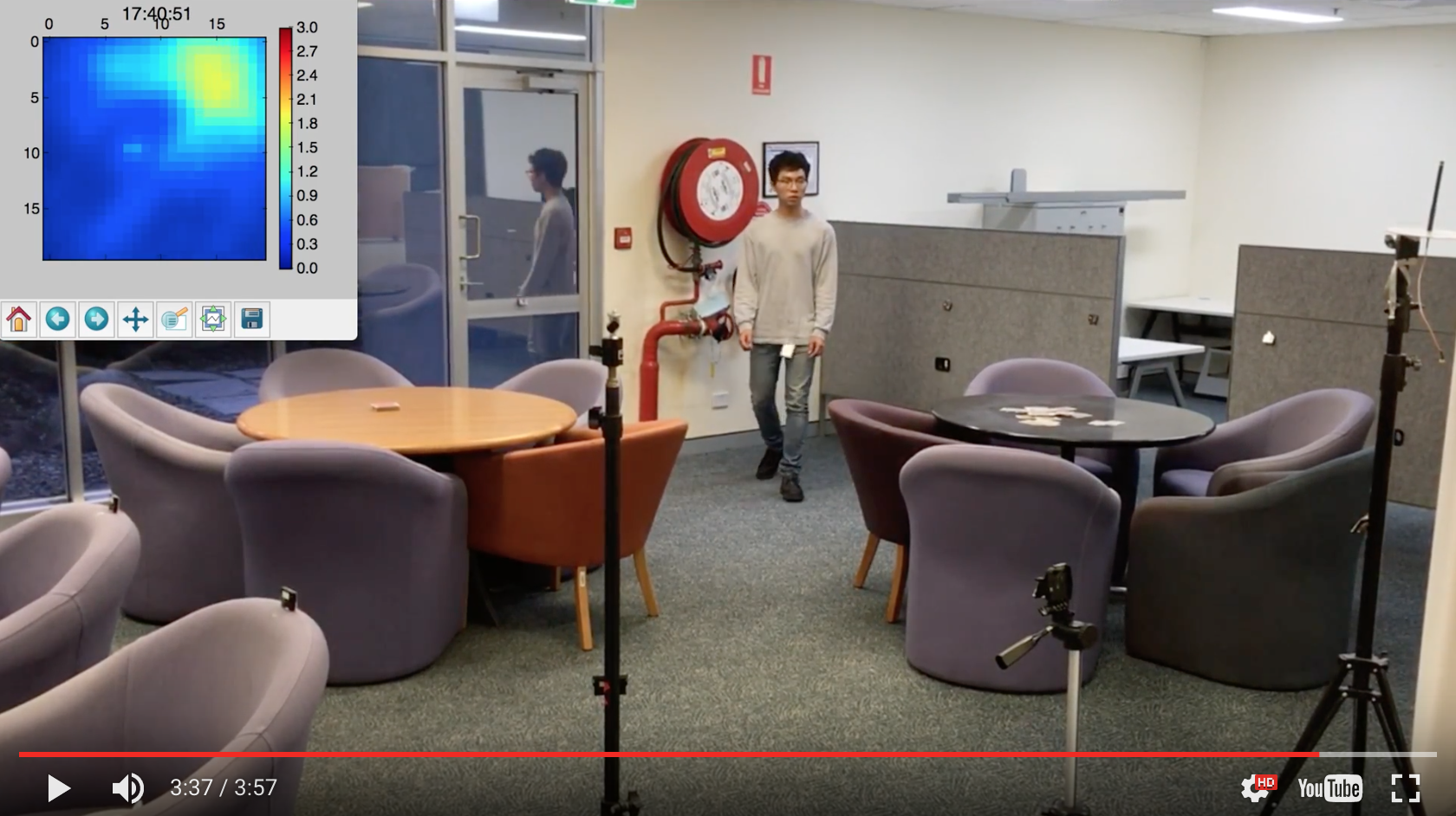
I followed the core reconstruction concept from:
Wilson & Patwari, Radio tomographic imaging with wireless networks [1]
The model links RSS-based measurements to an attenuation image:


Where:
- y: vector of RSS measurement differences
- W: weighting matrix
- x: attenuation image to estimate (in dB)
- Cₓ: prior covariance matrix
- σₙ⁻²: node variance term
I skip the full derivation (well covered in the paper) and focus on how I defined y in practice.
Three y-vector strategies
1) Cycle-to-cycle difference: (T_n - T_{n-1})
- Best spatial accuracy during continuous movement
- Weakness: when an object stops moving, it can fade from the image as the network adapts
2) Baseline difference: (T_n - T_0)
- Better for detecting slow or static objects
- Weakness: baseline drifts with environmental changes, so long runs become less reliable
3) Standard deviation-based y
- Similar quality to method 1
- Improved as iteration count increased
Conclusion
I used method 1 as the default because it gave the most stable overall results in my setup. Methods 2 and 3 are still useful alternatives depending on environment stability and runtime conditions.
Reference
[1] Wilson, Joey, and Neal Patwari. “Radio tomographic imaging with wireless networks.” IEEE Transactions on Mobile Computing 9.5 (2010): 621–632.
2026 Update Note
- Migrated and language-polished in 2026.
- The three y-vector strategies remain useful framing choices for RSSI-based reconstruction trade-offs.
- In current practice, this stage can be further improved with regularization tuning and adaptive baseline management.
이 기사는 저작권자의 CC BY 4.0 라이센스를 따릅니다.