Why OS-Level Demand Paging Fails on Apple Silicon GPU
I tried to use macOS demand paging to save GPU memory in llama.cpp. It didn't work — and understanding why led to a better approach.
The Problem: 8 GB of Memory for a 10-Token Conversation
In the previous post, I built a paged KV cache wrapper for llama.cpp. It tracked blocks, managed metadata, and correctly dispatched to the inner llama_kv_cache — but memory usage was identical to vanilla.
Why? Because the wrapper still allocated the full buffer upfront, and blocks were internally contiguous. The metadata-only approach saved nothing.
To actually save memory, I needed to go deeper: prevent physical memory from being committed for pages that aren’t used yet.
The Hypothesis: Demand Paging Should Work
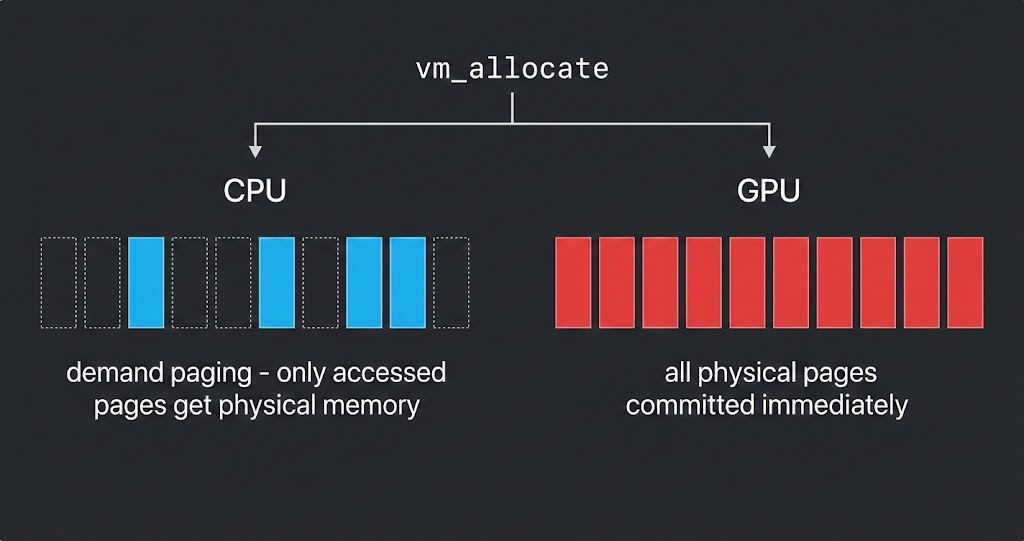
macOS uses demand paging for virtual memory. When you call vm_allocate, the OS reserves virtual address space but commits physical pages only on first access:
1
2
3
4
5
6
7
8
vm_allocate(4 GB)

Virtual:   [████████████████████████]  4 GB reserved (instant)
Physical:  [                        ]  0 bytes       (nothing committed)

First write → page fault:
  page[0]  → [█                       ]  16 KB committed
  page[3]  → [█  █                    ]  32 KB committed
Untouched pages consume zero physical RAM. This is how every modern OS manages memory.
I found that llama.cpp’s Metal backend uses exactly this mechanism:
1
2
3
4
5
6
7
// ggml-metal-device.m
kern_return_t err = vm_allocate(mach_task_self(), &data, size, VM_FLAGS_ANYWHERE);

res->buffers[0].metal = [device newBufferWithBytesNoCopy:data
                                                  length:size_aligned
                                                 options:MTLResourceStorageModeShared
                                             deallocator:nil];
Step 1 allocates virtual memory with demand paging. Step 2 wraps it as a Metal GPU buffer in shared mode (unified memory — CPU and GPU share the same physical RAM on Apple Silicon).
My plan was simple:
- Skip the
buffer_clear(buf, 0)call that touches every page - Let demand paging do its job — only pages written during inference get committed
- Use
madvise(MADV_FREE_REUSABLE)to release pages when sequences are deleted
Zero code changes to the compute path. Zero kernel modifications. Just stop touching pages that don’t need to be touched.
Testing with Small Models: It Works!
I implemented the plan and tested with Qwen2.5 (0.5B and 7B):
| Model | Context | Vanilla RSS | Paged RSS | Savings |
|---|---|---|---|---|
| 0.5B | 32K | 37 MB | 18 MB | 52% |
| 7B | 32K | 6.20 GB | 4.45 GB | 30% (1.8 GB) |
Promising! The 7B model saved 1.8 GB of real memory. The key fix was ensuring buffer_clear() was skipped — it was zero-filling the entire KV cache and touching every virtual page, defeating demand paging entirely.
Testing with 27B: It Doesn’t Work
Then I tested with Qwen3.5-27B, a 27B hybrid model with 64K context:
1
2
3
Vanilla RSS: 19.8 GB
Paged RSS:   19.9 GB
Savings:     0%
Zero savings. Not even a single megabyte.
The problem wasn’t demand paging itself. There were two issues:
Qwen3.5 is a hybrid architecture — 3/4 of its layers are recurrent (SSM), not attention. Our paged wrapper only covered
llama_kv_cache, which handles the attention layers. The SSM state memory was untouched.And the deeper issue… even for the attention layers,
newBufferWithBytesNoCopywas defeating demand paging entirely.
The Discovery: Metal Commits All Physical Pages
Through deeper testing and analysis, I discovered that newBufferWithBytesNoCopy commits all physical pages at buffer creation time, regardless of whether they’ve been touched:
1
2
3
4
5
6
7
Step 1 (vm_allocate):
  Virtual:  [████████████████]  4 GB
  Physical: [                ]  0 bytes  ← demand paging active

Step 2 (newBufferWithBytesNoCopy):
  Virtual:  [████████████████]  4 GB
  Physical: [████████████████]  4 GB     ← ALL pages committed!
The name “NoCopy” is misleading. It means “don’t copy the data” (use existing memory), not “don’t commit the pages.” When Metal creates a GPU buffer, it must register every virtual-to-physical page mapping in the GPU MMU — and unlike the CPU, the GPU has no page fault handler.
Why GPUs Can’t Do Demand Paging
1
2
3
4
5
6
7
CPU access pattern:
  page fault → kernel trap → allocate physical page → resume
  (transparent, the program never knows)

GPU access pattern:
  page fault → ??? → GPU hang / crash
  (no page fault handler exists on the GPU)
The CPU kernel can intercept page faults and lazily allocate physical memory. The GPU cannot. Therefore, Metal must ensure every page is physically backed before any GPU kernel could potentially access it. Even on Apple Silicon’s unified memory (same physical RAM for CPU and GPU), the GPU MMU operates differently from the CPU MMU.
Everything I Tried (and Failed)
| Attempt | Result | Why |
|---|---|---|
Skip buffer_clear | ❌ | newBufferWithBytesNoCopy already committed all pages |
madvise(MADV_FREE_REUSABLE) | ❌ | Metal holds references, OS can’t reclaim |
| MTL Residency Sets (lazy) | ❌ | Controls residency, not page commitment |
| Don’t touch the buffer at all | ❌ | Pages committed at MTLBuffer creation |
The Pivot: If You Can’t Make Big Buffers Lazy, Make Small Buffers
The realization was stark: no OS-level trick can save memory for Metal GPU buffers. The only way to use less memory is to allocate less memory.
1
2
3
4
5
Vanilla:    MTLBuffer(4 GB) → 4 GB physical RAM committed    💀
Dynamic:    MTLBuffer(16 MB) → 16 MB physical RAM committed  ✅
            → full? → MTLBuffer(32 MB) → copy → swap
            → full? → MTLBuffer(64 MB) → copy → swap
            → ...grow on demand
Instead of one big buffer with OS-level laziness (which doesn’t work on GPU), allocate a small contiguous buffer and grow it when needed. This is entirely application-level — no OS magic, no kernel modifications, no custom Metal shaders.
The Design Difference: vLLM vs Our Approach
This is fundamentally different from how vLLM solves the same problem:
graph LR
    subgraph "vLLM (Server)"
        P["Fixed GPU Pool"] --> BT["Block Table"]
        BT --> PK["PagedAttention Kernel"]
    end

    subgraph "Ours (Single Device)"
        S["Small Buffer"] --> R["try_resize()"]
        R --> L["Layer-by-Layer Copy"]
        L --> B["Bigger Buffer"]
    end
| Aspect | vLLM | Dynamic Resize |
|---|---|---|
| Memory savings from | Pool sharing across requests | Minimal initial allocation |
| Kernel changes | Custom PagedAttention kernel | None (standard ggml) |
| Memory layout | Non-contiguous (block table) | Contiguous (Metal-optimal) |
| Resize cost | None (pool internal) | Layer-by-layer copy (~45ms) |
| Implementation | Very complex (~1000s LOC) | Simple (~200 LOC) |
| Best for | Servers (many concurrent requests) | Personal devices (single user) |
vLLM’s approach requires custom GPU kernels that handle non-contiguous memory access via block tables. On Metal, writing custom GPU kernels is impractical — Apple’s Metal Shading Language ecosystem doesn’t have the same level of community tooling as CUDA. Our approach works with Metal’s contiguous memory model instead of against it.
What’s Next
The next post covers the implementation: try_resize(), the doubling-to-linear growth strategy, and benchmark results showing 8.3 GB memory savings on a 27B model with zero GPU OOM crashes.
This is part 2 of a 3-part series on KV cache optimization in llama.cpp. Part 1 covers the initial PagedAttention implementation. Part 3 covers the Dynamic Resize implementation and benchmarks.