Dynamic KV Cache Resize in llama.cpp — 8 GB Savings on a 27B Model
Start with 16 MB and grow on demand. An experimental llama.cpp patch that reduced upfront KV allocation and avoided GPU OOM on Apple Silicon.
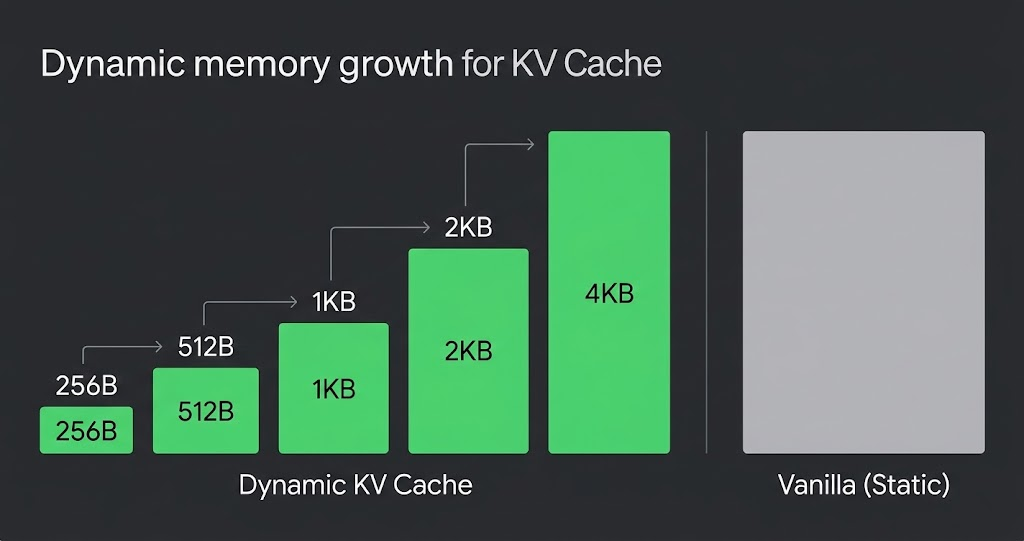
From 8 GB Upfront to 16 MB on Demand
In the previous post, I discovered that Metal GPU buffers commit all physical pages at creation time — OS-level demand paging doesn’t work. The only way to save memory is to allocate smaller buffers and grow them.
This post covers the implementation, the optimizations that made it practical, and the benchmark results.
How It Works
The idea is straightforward:
- Start small — allocate a KV cache with 256 cells instead of the full context size
- Grow on demand — when
init_batch()fails because the cache is full, calltry_resize()to allocate a bigger cache, copy existing data, and retry - Re-reserve the scheduler — after
init_batch()triggers a resize,llama_contextnotices the resize flag and re-reserves compute buffers before graph execution
flowchart TD
    A["init_batch()"] --> B{"prepare() succeeds?"}
    B -->|Yes| C["Return context"]
    B -->|No| D{"kv_size_max > 0?"}
    D -->|No| E["Return FAILED"]
    D -->|Yes| F["try_resize()"]
    F --> G["Allocate bigger cache"]
    G --> H["copy_from() layer by layer"]
    H --> I["Swap internals"]
    I --> J["prepare() again"]
    J --> C
The --kv-dynamic flag enables this. When disabled, behavior is identical to upstream llama.cpp.
The try_resize() Implementation
The core of the resize is a create-copy-swap pattern:
1
2
3
4
5
6
7
8
9
10
11
12
13
14
15
16
17
18
bool llama_kv_cache::try_resize() {
    // calculate new size with growth strategy
    uint32_t new_size = calculate_growth(kv_size_cur);

    // create a temporary cache with the new size;
    // kv_size_max=0 disables the "start at 256" logic for the temp cache
    llama_kv_cache tmp(model, saved_type_k, saved_type_v, ...
                       new_size, ... /* kv_size_max = */ 0);

    // copy existing data layer by layer
    tmp.copy_from(*this);

    // steal the internals
    ctxs_bufs = std::move(tmp.ctxs_bufs);
    layers    = std::move(tmp.layers);
    v_cells   = std::move(tmp.v_cells);
    v_heads   = std::move(tmp.v_heads);
}
When tmp goes out of scope, the old (smaller) buffers are freed. The cache now has a bigger backing store with all existing KV data preserved.
Layer-by-Layer, Stream-by-Stream Copy
The copy_from() method copies tensor data through a CPU staging buffer one layer at a time, and one stream view at a time:
1
2
3
4
5
6
7
8
9
10
11
void llama_kv_cache::copy_from(const llama_kv_cache & other) {
    for (size_t il = 0; il < layers.size(); ++il) {
        for (size_t s = 0; s < other.layers[il].k_stream.size(); ++s) {
            std::vector<uint8_t> staging(ggml_nbytes(other.layers[il].k_stream[s]));
            ggml_backend_tensor_get(other.layers[il].k_stream[s], staging.data(), 0, staging.size());
            ggml_backend_tensor_set(layers[il].k_stream[s], staging.data(), 0, staging.size());
        }

        // same pattern for V stream views
    }
}
This is critical for memory efficiency. A naive approach would allocate the new cache and copy the whole KV region in one shot. The current code limits the staging buffer to one layer/stream view at a time.
The current version also keeps KV buffers zero-initialized. The memory savings come from starting with a much smaller cache, not from leaving padding or future rows uninitialized.
Growth Strategy: The 4→8 GB Jump Problem
My first implementation used simple doubling: 256 → 512 → 1K → 2K → … → 64K → 128K.
The problem is what happens at large sizes:
1
2
3
Doubling:   ... → 32K (2 GB) → 64K (4 GB) → 128K (8 GB) → 💥 GPU OOM
                                              ↑
                                         4 GB jump!
On a 32 GB system with a 27B model (~16 GB), the available RAM for KV cache is ~6-7 GB. A 4→8 GB jump overshoots and crashes immediately.
The fix: linear-ish growth after a small-cache phase.
1
2
3
Doubling + Linear:
  ... → 32K (2 GB) → 49K (3 GB) → 65K (4 GB) → 81K (5 GB) → 98K (6 GB)
                     ↑ +1 GB       ↑ +1 GB      ↑ +1 GB      ↑ +1 GB
The current implementation uses a simple heuristic:
1
2
3
4
5
6
7
8
9
if (kv_size_cur < 4096) {
    new_size = kv_size_cur * 2;
} else {
    const size_t total = total_size();
    const size_t per_cell = total / kv_size_cur;
    const uint32_t cells_per_gb =
        per_cell > 0 ? (uint32_t) (1024ULL * 1024 * 1024 / per_cell) : kv_size_cur;
    new_size = kv_size_cur + std::max(cells_per_gb, 256u);
}
So the switch point is currently a fixed 4096 cells. The “+1 GB” step is still derived from the model’s actual current KV footprint, but the threshold itself is just a heuristic.
The Hybrid Model Gotcha
Qwen3.5-27B uses a hybrid architecture — 16 attention layers and 64 recurrent (SSM) layers. These are managed by llama_memory_hybrid, which internally wraps a llama_kv_cache for attention and a llama_memory_recurrent for SSM state.
My initial implementation only added dynamic resize to the standalone llama_kv_cache path. Hybrid models take a different code path through llama_memory_hybrid, so the dynamic parameters weren’t forwarded:
1
2
3
4
5
6
7
8
9
10
// Before: hybrid path didn't forward kv_dynamic
res = new llama_memory_hybrid(model, type_k, type_v, ...
                              offload, unified,
                              filter_attn, filter_recr);

// After: forward kv_size_max into the attention KV cache path
res = new llama_memory_hybrid(model, type_k, type_v, ...
                              offload, unified,
                              filter_attn, filter_recr,
                              cparams.kv_dynamic ? cparams.n_ctx_seq : 0);
The hybrid model’s init_batch() also needed its own retry logic:
1
2
3
4
5
6
7
auto heads_attn = mem_attn->prepare(ubatches);
while (heads_attn.empty()) {
    if (!mem_attn->try_resize()) {
        break;
    }
    heads_attn = mem_attn->prepare(ubatches);
}
Benchmark Results: Vanilla vs Dynamic
Hardware: Apple M4 Mac Mini, 32 GB unified memory
Model: Qwen3.5-27B Q4_K_M (hybrid architecture)
Context: 131,072 tokens (-c 131072)
Vanilla (8 GB KV cache allocated upfront)
| Prompt Tokens | Gen t/s | RSS (MB) | KV (MB) | Status |
|---|---|---|---|---|
| 89 | 4.34 | 24,474 | 8,192 | ✅ (1 success out of 5 runs) |
| 809 | — | 10,765 | 8,192 | ❌ GPU OOM |
| 6,409 | — | 24,421 | 8,192 | ❌ GPU OOM |
| 25,609 | — | 24,458 | 8,192 | ❌ GPU OOM |
| 40,009 | — | 24,447 | 8,192 | ❌ GPU OOM |
4 out of 5 tests crashed with kIOGPUCommandBufferCallbackErrorOutOfMemory. Metal GPU buffers can’t be swapped — when physical RAM runs out, the GPU crashes.
Dynamic (start at 256 cells, grow on demand)
| Prompt Tokens | Gen t/s | RSS (MB) | KV (MB) | KV Cells | Resizes | GPU OOM |
|---|---|---|---|---|---|---|
| 89 | 4.66 | 16,145 | 16 | 256 | 0 | 0 |
| 809 | 4.66 | 16,197 | 64 | 1,024 | 2 | 0 |
| 6,409 | 4.47 | 16,464 | 512 | 8,192 | 5 | 0 |
| 25,609 | 3.78 | 17,322 | 2,048 | 32,768 | 7 | 0 |
| 40,009 | 3.27 | 18,413 | 3,072 | 49,152 | 8 | 0 |
| 64,009 | 2.65 | 19,514 | 4,096 | 65,536 | 9 | 0 |
| 80,009 | 2.32 | 19,002 | 5,120 | 81,920 | 10 | 0 |
All 7 tests completed successfully. Zero GPU OOM. Zero swap (up to 64K tokens).
The Numbers That Matter
| Metric | Vanilla | Dynamic |
|---|---|---|
| GPU OOM rate at 131K context | 80% (4/5 crashed) | 0% (7/7 stable) |
| Max usable tokens | ~89 (unreliable) | 80K+ |
| RSS at 89 tokens | 24,474 MB | 16,145 MB (-8.3 GB) |
| Swap at 1K tokens | +1,560 MB | 0 MB |
The TPS decrease from 4.66 (1K) to 2.32 (80K) is expected — it’s caused by attention’s O(n²) complexity scaling with context length, not by the dynamic resize mechanism.
The Final Code
The current implementation is 215 insertions and 7 deletions across 11 files:
1
2
3
4
5
6
7
8
9
10
11
12
 common/arg.cpp              |   7 +++
 common/common.cpp           |   1 +
 common/common.h             |   1 +
 include/llama.h             |   1 +
 src/llama-context.cpp       |  29 ++++++++++
 src/llama-cparams.h         |   1 +
 src/llama-kv-cache.cpp      | 133 +++++++++++++++++++++++++++++++++++++++++++-
 src/llama-kv-cache.h        |  26 ++++++++-
 src/llama-memory-hybrid.cpp |  13 ++++-
 src/llama-memory-hybrid.h   |   4 +-
 src/llama-model.cpp         |   6 +-
 11 files changed, 215 insertions(+), 7 deletions(-)
No custom GPU kernels. No new wrapper classes. No ggml modifications. Just growth logic inside the existing llama_kv_cache class, triggered automatically when the cache is full and --kv-dynamic is enabled.
Try It
1
2
3
4
5
6
7
8
9
git clone https://github.com/rockyRunnr/llama.cpp
cd llama.cpp && git checkout feature/dynamic-kv-cache
cmake -B build -DGGML_METAL=ON && cmake --build build -j

./build/bin/llama-completion \
    -m your-model.gguf \
    -c 131072 \
    --kv-dynamic \
    -p "Your prompt here" -n 100
Watch the logs for dynamic KV cache: start = 256 cells and resizing KV cache from X to Y cells.
This is part 3 of a 3-part series on KV cache optimization in llama.cpp. Part 1 covers the initial architecture analysis. Part 2 covers the demand paging investigation and Metal discovery.