From Search to Decisions: A Recall Skill for Codex
Part 4: integrating Recall into everyday engineering, making decisions traceable, and testing whether past settings can be reused without repeat questions.
Personal Session Memory · Part 4 of 4
1. Archive · 2. Retrieval · 3. Operations · 4. Recall
Finding an Old Answer Is Only Half the Goal
The archive and retrieval service made an obvious workflow possible: ask what I did before and find the relevant conversation.
The more interesting workflow starts without a history question at all. I give Codex a new task. It examines the current code and constraints, identifies a decision that could benefit from prior evidence, and forms the search question itself.
For example, “make this batch more reliable” may lead to a question about my earlier choices between another retry, better diagnostics, and a larger redesign. I do not want to supply every search term manually. I also do not want a retrieved sentence to become a permanent rule about what I supposedly prefer.
This final part describes the bridge between retrieval and judgment: an instruction-only skill called Recall, which I use in my regular engineering workflow.
A Skill Was Enough for the First Integration
Session Search already had a CLI and an authenticated local API. I did not need to add an MCP server merely to let Codex use those interfaces on the same Mac.
The skill defines a procedure around the existing tools. It does not contain the conversation corpus, load an embedding model, or introduce another database. Retrieval stays in Session Search; interpretation stays with Codex.
OpenAI’s skills documentation describes SKILL.md metadata and explicit or implicit activation. I enabled implicit invocation but used a narrow description. Matching is model-dependent; it is not a guarantee that every vaguely related prompt will activate the skill.
The canonical skill source lives beside the retrieval code, with a user-scoped skill-directory symlink pointing to it. That avoids maintaining divergent copies. Here is a shortened, generalized version of its front matter:
1
2
3
4
5
6
7
---
name: recall
description: >-
  Retrieve archived conversations and decision evidence. Use for past-session
  lookup or when the user asks to consult past judgments in a current task.
  Do not activate for ordinary coding without a request to use personal history.
---
The actual evidence-reading and confirmation instructions follow the front matter. Optional agents/openai.yaml metadata gives it the display name Recall and sets allow_implicit_invocation: true.
These files govern a workflow. They do not grant permissions or create a new security boundary.
Two Ways to Ask for Recall
In Codex CLI, I can explicitly name the skill:
1
2
$recall Find the earlier discussion about index storage growth.
Show the measurements and the decision we made.
That is a memory lookup. I already know I want something from the past.
For a new task, I can instead opt into history-informed work:
1
For this task, also consult my past decisions before recommending an approach.
The skill should then use the current task to decide what is worth retrieving. It is not meant to trigger a history search for every trivial edit or general-knowledge question.
The backend remains usable without the skill. If the integration behaves unexpectedly, I can test the same query through the CLI and distinguish a retrieval problem from a workflow problem.
The Workflow: Current Context, Historical Evidence, Then Judgment
For a new task, the intended procedure is:
- Inspect the present situation. Read the relevant code, files, goal, and constraints.
- Identify the decision. Find a choice where history could materially help.
- Form a focused query. Supply only the necessary current context, not whole repositories or secrets.
- Retrieve a small candidate set. Treat a high rank as a lead, not a verdict.
- Verify the evidence. Read the original event and surrounding conversation before attributing a decision to me.
- Explain the application. Separate the historical fact, current interpretation, and proposed action.
Codex performs the query-generation step under the skill’s instructions. There is no extra query-generating LLM hidden inside Session Search.
The distinction between a search hit and verified evidence is essential. A tool result may quote an earlier answer. An assistant may have proposed something that I later rejected. A neighboring event may belong to another branch. None of these should quietly become “you decided this.”
The retrieval API supplies event IDs, revisions, and a generation for follow-up reads. If that generation has been retired, the workflow needs a fresh search rather than pretending an old reference still resolves to the same material.
A New-Task Example
The following is an illustrative interaction, not a measured production result or a quotation from a work project.
Task: Make this new nightly batch more reliable. It occasionally finishes without producing its result file.
The agent notices that the code retries without preserving enough information to explain failures. Instead of asking the archive “how do I make batches reliable?”, it generates a narrower question:
In previous batch failures, when did the user prefer bounded diagnostics over another blind retry?
A useful answer would connect the old conditions to the new ones:
In that earlier case, repeated retries had not explained the failure, and diagnostic overhead needed to stay small. This batch has a similar symptom but different latency constraints. I suggest bounded timing and error-stage logging first. Should I apply that preference here?
An unhelpful answer would be:
You always prefer more logging, so I enabled verbose tracing everywhere.
Both might originate from a related search hit. Only the first preserves the conditions and uncertainty that made the original evidence meaningful.
If there is no usable history, the agent can still make an ordinary technical recommendation. It should simply stop claiming that the recommendation represents my established preference.
Retrieval Is Not Authorization
My default rule is to ask before applying an inferred preference unless I explicitly waive that confirmation for the current task.
That does not mean asking permission before every search. It means distinguishing “I found evidence worth considering” from “I am authorized to make this decision on your behalf.” Long-running or overnight work does not automatically waive that distinction.
The skill treats retrieved text as untrusted historical evidence:
- An old command is not an instruction to execute it now.
- An old approval does not authorize a different operation in a new task.
- A proposal from an assistant is not automatically my decision.
- A previous preference may have depended on a budget, dataset, deadline, or project that no longer applies.
Its lookup procedure uses search and evidence-reading commands, not indexing, installation, or repair commands. Ordinary authorized project work remains separate. This is an instruction-level workflow policy, not an additional sandbox replacing the agent’s existing permissions.
Make Delegated Decisions Reviewable
Confirmation before a decision and a recap after the work solve different problems. Even when I explicitly delegate judgment, I want to know where Recall influenced the result.
The final handoff should summarize material choices:
| Item | What the recap should show |
|---|---|
| Decision | What required a preference or judgment? |
| Evidence | Which original records were checked? |
| Interpretation | Why might the old reasoning apply now? |
| Action | What was actually done, rather than merely proposed? |
| Authority | Was it confirmed, explicitly delegated, or left pending? |
| Uncertainty | What still needs verification or my review? |
These notes stay task-scoped. I did not add a growing global AGENTS.md full of guessed preferences or a separate permanent personality database. Silence is not a confirmed preference, and a useful historical answer is not automatically an evaluation label.
Local Retrieval Is Not an Entirely Offline Workflow
The archive, embeddings, vector database, and retrieval service run locally. When a hosted coding agent reads retrieved passages, however, those passages enter its model context.
That boundary has to be acceptable for the data involved. A namespace is not access control, and excluding credential-store files does not remove sensitive content already present in transcripts. The operational dashboard exposes metrics instead of full conversations, but the retrieval workflow intentionally returns text.
This series omits private hostnames, NAS addresses, credentials, actual conversation identifiers, and work-session contents. That is a publication precaution, not proof that every record in a private archive is safe to send to an external model.
Measured: Reusing Decisions Without Asking Again
On September 29, I tested whether the agent could apply choices I had already recorded without asking me to repeat them. Three configuration tasks covered the index update schedule and retention policy, the ChatGPT export workflow, and the dashboard’s language and style. The reference choices came from original conversations and were confirmed by me.
Both conditions received the same current instructions and project files, with the same model settings. Without Recall, the agent had no historical retrieval. With Recall, it could generate its own searches and inspect a frozen copy of my archived conversations using the skill. Answers to the history-dependent tasks were not supplied in either condition’s instructions or files.
A successful run had to produce the correct configuration and finish without a follow-up question. A test script compared the output settings with the reference values; it did not award success merely because the agent said it was done.
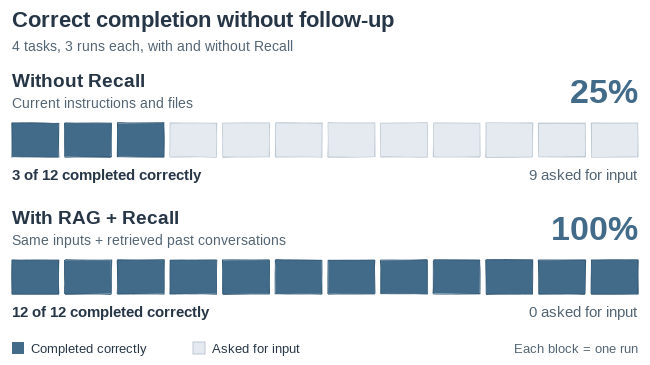 Correct completion without a follow-up rose from 25% to 100% in this configuration test. Each block is one run, not a different project.
The comparison also checked the boundaries of using history:
| Check | Without Recall | With Recall |
|---|---|---|
| Apply three recorded choices, three runs each | 0/9 completed without asking | 9/9 completed without asking |
| Follow a new instruction instead of an older choice | 3/3 correct completions | 3/3 correct completions |
| Ask when a required value was unknown | 3/3 appropriate questions | 3/3 appropriate questions |
The chart combines the first two rows: 12 runs per condition, with follow-up requests falling from 9 to 0. The unknown-value check is separate because asking was the correct action. Five cases, two conditions, and three fresh runs per case made 30 configuration runs in total. There were no incorrect configurations or timeouts. Aggregate results are published without source conversations or identifying records.
The baseline was not wrong to ask: the earlier choices were absent from its inputs. This result measures the value of access to recorded decisions, not a smarter underlying model. The historical choices came from one project conversation, and repeating each case three times checks consistency only on those cases. It does not establish a general coding completion rate, faster search, or hours saved on overnight work. I confirmed the reference decisions, but did not individually approve every generated response.
For my workflow, the useful result is concrete: established settings could be applied without another handoff, while missing information and new instructions still received the appropriate treatment. For new engineering decisions, I continue to rely on real use, source-linked decision reports, and feedback about where old reasoning does or does not apply.
A Searchable History, Not a Replica of Me
The system is useful because its boundaries are explicit. The archive preserves evidence. Retrieval finds candidate passages. The skill guides verification and interpretation. Current instructions determine what may actually be done.
I have not trained an autonomous replica of myself. I have made it easier for a coding agent—and for me—to recover reasoning that would otherwise remain buried in old sessions.
That is the kind of memory I wanted to start with.
Previous: Storage, Recovery, and Observability · Start of the series: Building a Durable Archive